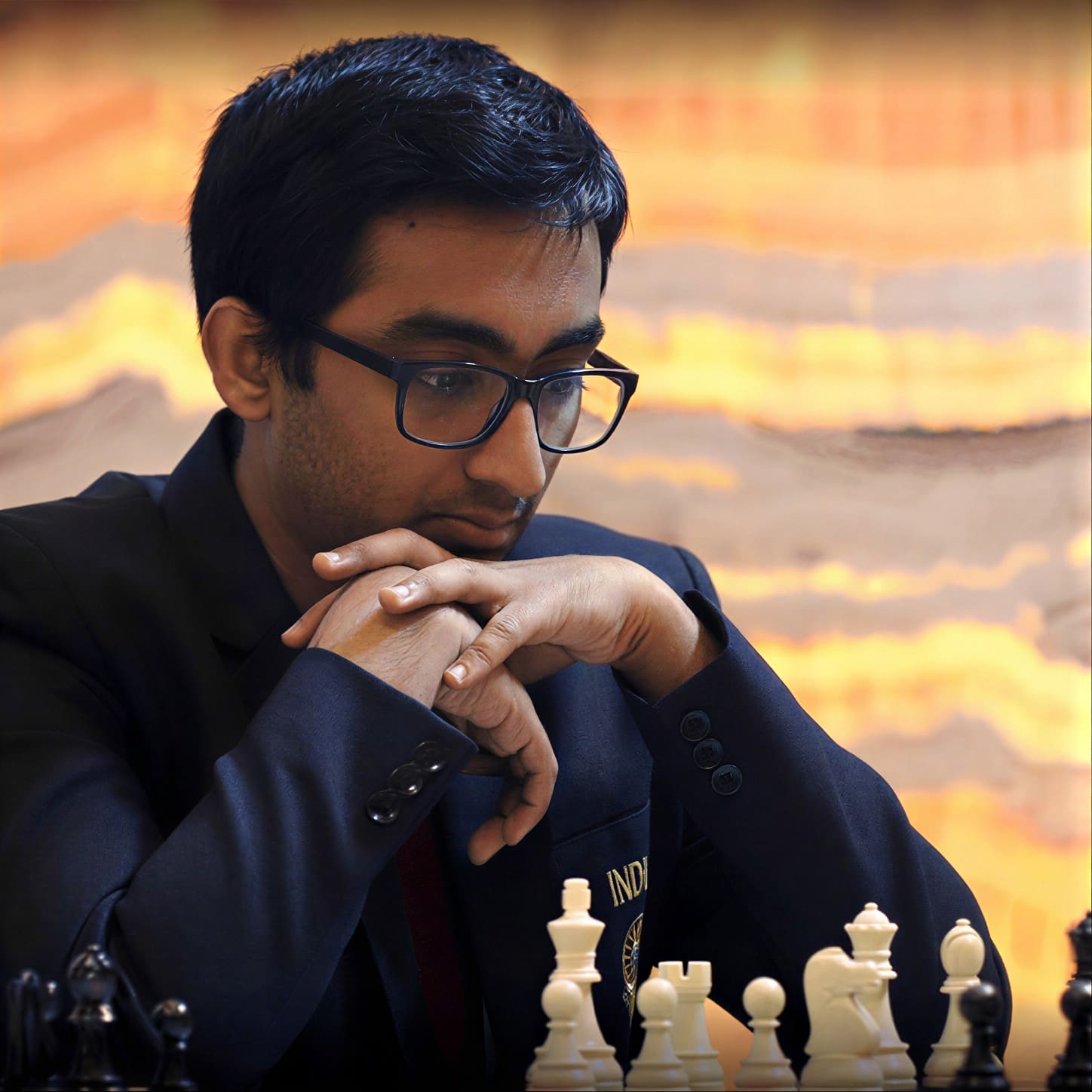
Raghunandan KS
About Me
Hello! I am 25-year-old International Master Raghunandan KS from India. I have 1 GM norm and a FIDE rating of 2441. I started learning chess in 2008 when I was around 7.5 years old. I became an IM in 2016 at the age of 14 years and 12 months. I have won medals in World Youth, Asian Youth, and Asian Junior Championships.
Personal Goal
While my current focus is on coaching and streaming, I remain deeply committed to my own growth as a player. My goal is to fulfill my potential and reach the highest levels of competitive play.
International Highlights
Streaming
I plan to start streaming regularly, to share high-level chess insights while solving tactics and playing blitz for both fun and the improvement of my own game.
Coaching
Coaching Information
I offer both one-to-one and group lessons for players from beginner level up to 2300. I have been coaching for over 2 years and currently work with students ranging from beginners to 2100+, the majority of whom are rated 1900+. Several of my current students have gained hundreds of rating points in less than a year.
Teaching Methodology
I can adapt my teaching approach to the individual needs and preferences of the student. My sessions are highly interactive, and my coaching is structured as follows:
1. Evaluation: First, I will look at the recent tournament games of the student. If no recent games have been played, I will show a set of positions and ask the student to speak aloud their thought process. This will help me clearly evaluate their strengths and weaknesses.
2. Work: Once that's done, we will work on all areas of the game with a specific focus on fixing their weaknesses. Beyond simply teaching new concepts, I focus on improving the student's thought process so that they can find the best moves independently, even in positions they have never seen before.
3. Guidance: I will guide the student on exactly 'how' and 'what' to work on in order to improve quickly. I also provide text support between sessions.
Availability & Frequency
I am available for regular sessions, as I am not actively playing tournaments at the moment. Consistency is key to progress: 4 sessions per month provides a solid foundation for improvement, while 8 or more sessions per month is recommended for those seeking rapid results.
Improvement Guide
Success in chess requires a balanced approach to study and practice. Below are my recommended resources and methodologies for players at various levels.
Recommended Reading List
0-1400 Rating:
- Yasser Seirawan - Play Winning Chess
- Yasser Seirawan - Winning Chess Tactics
- Masetti & Messa - 1001 Chess Exercises for Beginners
- John Emms - Discovering Chess Openings
1400-2000 Rating:
- Artur Yusupov - The Fundamentals Series (Volumes 1-3 & Revision 1)
- Artur Yusupov - Beyond the Basics Series (Volumes 1-3)
- Artur Yusupov - Mastery Series (Volumes 1-3)
- Jesus De La Villa - 100 Endgames You Must Know
- Jan Markos - Under the Surface
2000-2400 Rating:
- Johan Hellsten - Mastering Strategy Series (Opening, Chess, Defense, Endgame)
- Lars Bo Hansen - Secrets of Chess Endgame Strategy
- John Nunn - Understanding Chess Middlegames
- Ramesh RB - Fundamental Chess - Logical Decision Making
- Mauricio Flores Rios - Chess Structures & Chess Imbalances
- Sakaev & Landa - The Complete Manual of Positional Chess (Volumes 1-2)
How to Study Chess Books
Many chess books include both illustrative examples and exercise positions. Illustrative examples should be played through on a physical board while carefully reading the explanations and attempting to understand every concept. For exercises, try to solve them without moving the pieces, generally allowing up to 10 minutes per position (writing down the solution is optional), and then check it against the provided answer afterward.
Software & Tools
Applications: ChessX (Free), Chessbase (Professional), or Hiarcs Chess Explorer Pro (Professional).
Databases: Big Database is recommended; Mega Database is only necessary if you require annotated games and is generally not worth the additional cost.
Analysis: Stockfish is the industry-standard engine for preparation and analysis.
Tactics Training: Puzzles on Chess.com, Lichess, and Chesstempo are the best sources for daily practice.
Training Habits
Working Hours: For serious players, 4-5 hours of study per day is recommended; naturally, more is beneficial.
Division of Labor: Dedicate the majority of your time to middlegames and endgames. Below 2400, opening theory is less critical; spending 20% of your total study time on openings is sufficient.
The Role of a Coach: A coach plays a small but important role in the development of a player. A coach can provide essential analysis of tournament games, identify and address weaknesses, and offer guidance for home practice. While not strictly essential, working with a coach can significantly accelerate improvement.
Tournament Play
Volume: For professional players in the 1400-2400 range, I recommend 8-12 classical tournaments per year.
Selection Strategy: Facing stronger players more frequently is optimal for both rating and strength improvement. To achieve this, select tournaments by focusing on two factors: first, the average rating of the field should be close to your own; second, your starting rank should ideally be lower relative to the total field. For instance, in a 100-player tournament, a rank of 51 or higher ensures you face a higher-rated opponent in the first round, while 50 or lower results in a lower-rated opponent. You can similarly estimate the rating of opponents in future rounds based on your initial rank and decide whether to participate based on how many lower-rated matchups you are willing to face.